Plumb
Nothing leaves until it’s true.
Nothing leaves until it’s true.
- 01Light ‘ink-on-paper’, not another dark terminal
- 02Make confirmation effortful — on purpose
- 03Lead the checker with a diff, not a form
A desktop release terminal · the irreversible-money moment, designed to prevent the catastrophic miss
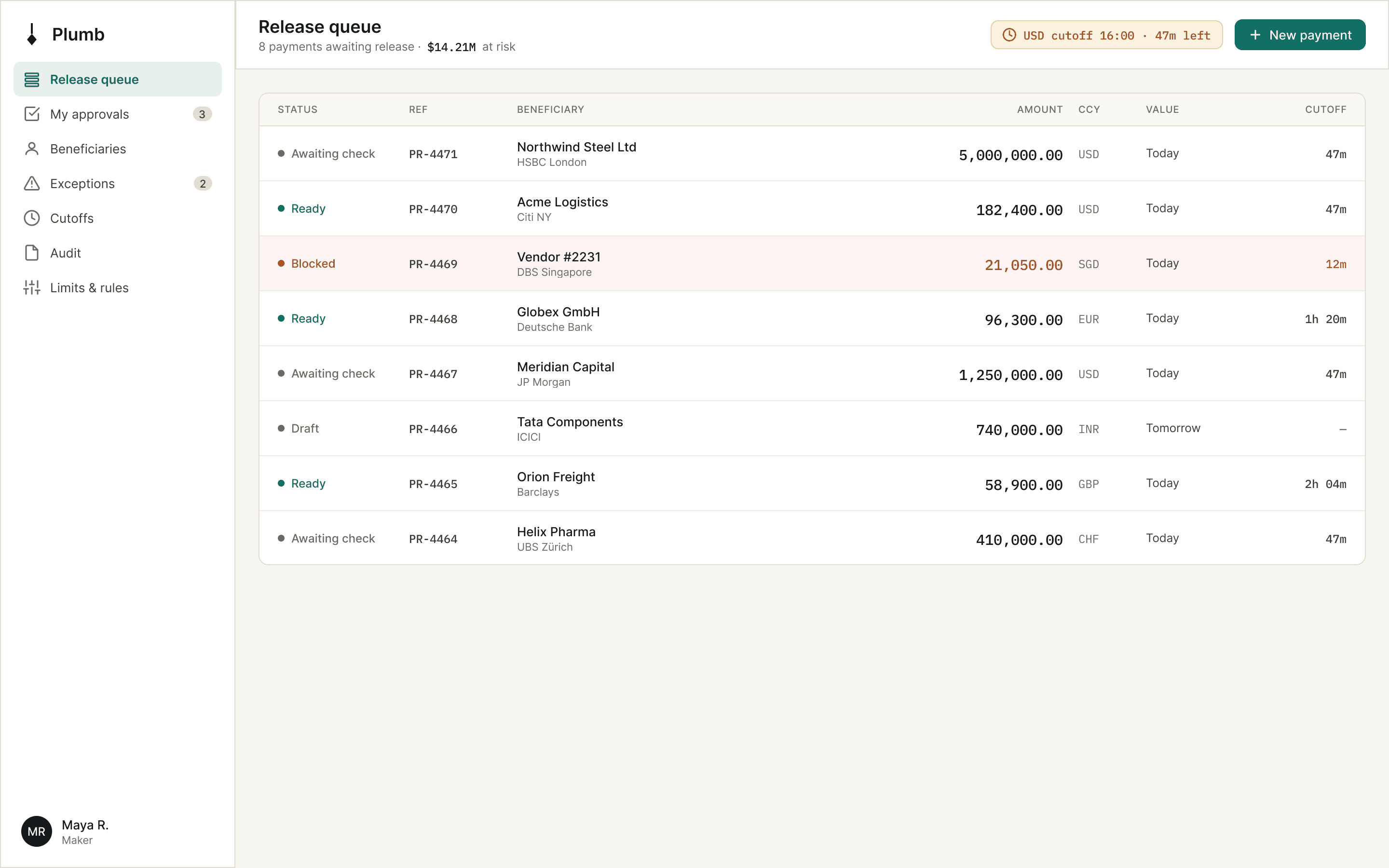
Releasing a high-value wire is a single human action that moves real money in seconds and usually can’t be clawed back — yet the tools optimise for speed (Bloomberg) or bolt control onto decades-old forms (bank portals). Plumb is a desktop terminal built for that one irreversible moment: it makes a dense payment instruction instantly legible, forces the operator to actively confirm the amount, and rebuilds four-eyes review around what actually changed — so the catastrophic miss is caught before money leaves the building.
A mis-keyed digit or a stale beneficiary on an outbound wire is irreversible and instantly catastrophic. The precedents are real (gathered from press during research, and flagged as such in the work): Citigroup’s 2022 input slip entered a ~$444bn order instead of ~$58m; Deutsche Bank once paid a hedge fund $6bn confusing gross for net. Misdirected-payment and business-email-compromise fraud, which quietly change the beneficiary account, drive billions in losses a year. The deeper problem is the tools: payment-ops analysts re-key across separate portals and spreadsheets, and four-eyes ‘maker-checker’ controls are bolted onto interfaces never designed for them — so the checker re-approves a flat list of 40 identical-looking fields without truly seeing what changed. Existing software prizes either speed (Bloomberg) or control (bank portals), but none makes the release moment itself its design surface.
The release moment gets one chance
Unlike a reconciliation exception (cleaned up after the fact), a wire moves real money in seconds and can’t be clawed back. The UX has exactly one shot to prevent the mistake.
Four-eyes is often theatre
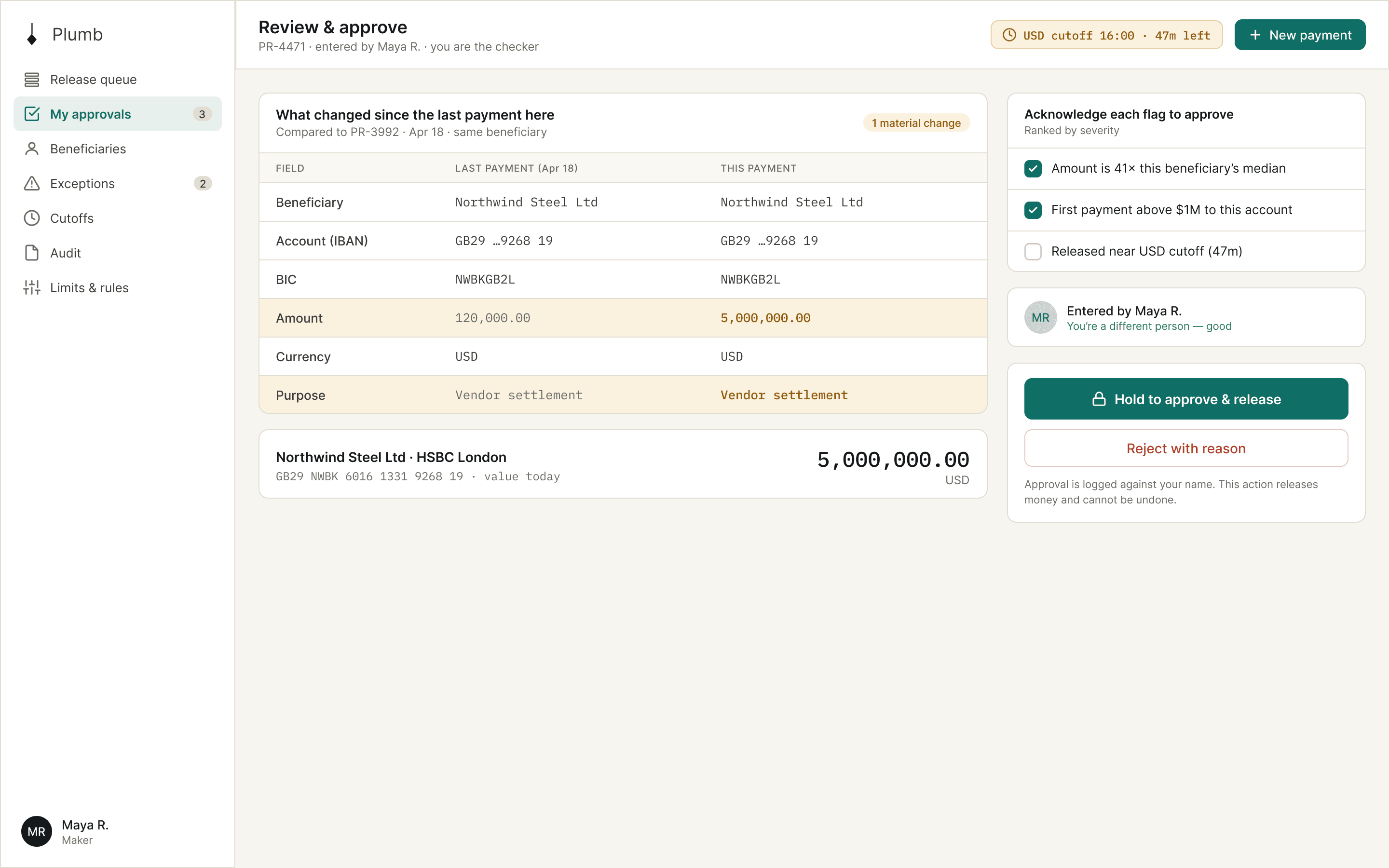
Maker-checker is a core financial control, but bolted onto a flat field list the checker re-approves what they can’t really see. Real review needs the diff up front.
Fraud attacks the account, not the amount
Misdirected-payment and BEC fraud quietly change the beneficiary account. So the beneficiary record — not just the payment — has to be the dual-controlled, diffed surface.
Two people, one irreversible action — designed to be deliberate, not slow.
Light ‘ink-on-paper’, not another dark terminal
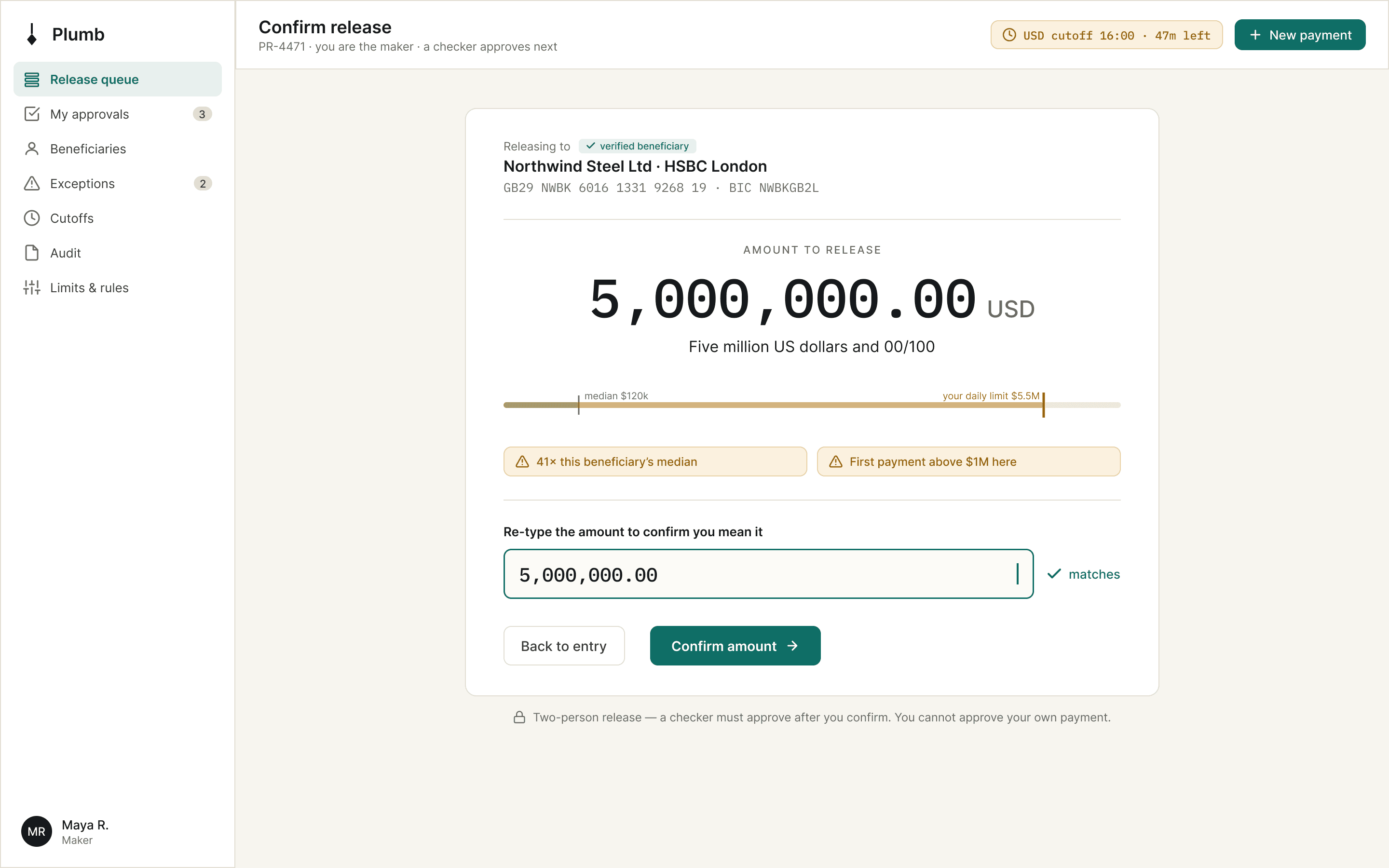
Chose a high-contrast, document-like light UI so amounts and IBANs are maximally legible and color is reserved to mean something — a signal (caution, stop, cleared, verified), never decoration. Tradeoff: it defies the ‘serious finance = dark Bloomberg’ expectation and looks less ‘hardcore’ — the bet is that fewer misreads matters more than looking the part.
Make confirmation effortful — on purpose
The Confirm-the-Amount ritual renders the figure three ways at once — grouped digits, amount-in-words, and a scale bar against this beneficiary’s history and the operator’s limit — and requires actively re-typing it to proceed. Tradeoff: a few deliberate seconds at exactly the dangerous step, while everything else stays keyboard-fast — because a slow safe tool gets bypassed under cutoff pressure, but a 10× or 100× slip has to be physically caught, not skimmed past.
Lead the checker with a diff, not a form
Four-eyes is rebuilt around ‘what changed and what’s anomalous’ — the review screen opens on a diff against the last payment to this beneficiary, with the changed amount highlighted and each ranked flag requiring acknowledgement. Tradeoff: more deliberate approvals, in exchange for turning rubber-stamping back into real review that catches a changed beneficiary or an outlier amount.
Explainable flags, never a black-box score
Every anomaly is a plain-language, ranked reason (‘41× this beneficiary’s median’, ‘account changed 3 hours ago’, ‘near currency cutoff’) — not an ML risk number. Tradeoff: more design work per rule and less ‘AI magic’, but a flag the operator can understand and act on, which is the whole point of keeping a human in control.
Treat reference data as the real threat surface
Beneficiary/account changes are first-class: dual-controlled, diffed before→after, timestamped, and shown with their provenance — because misdirected-payment fraud attacks the account, not the amount. Tradeoff: more friction on a ‘boring’ settings edit, placed exactly where the costliest fraud actually happens.
- ✕Speed (Bloomberg) or bolt-on control
- ✕Amount shown only to glance past
- ✕Checker sees a flat 40-field list
- ✕Beneficiary changes buried in settings
- ✓Legibility + a deliberate amount ritual
- ✓Re-affirm the magnitude before release
- ✓Four-eyes led by the diff + ranked flags
- ✓Dual-controlled, diffed beneficiary edits
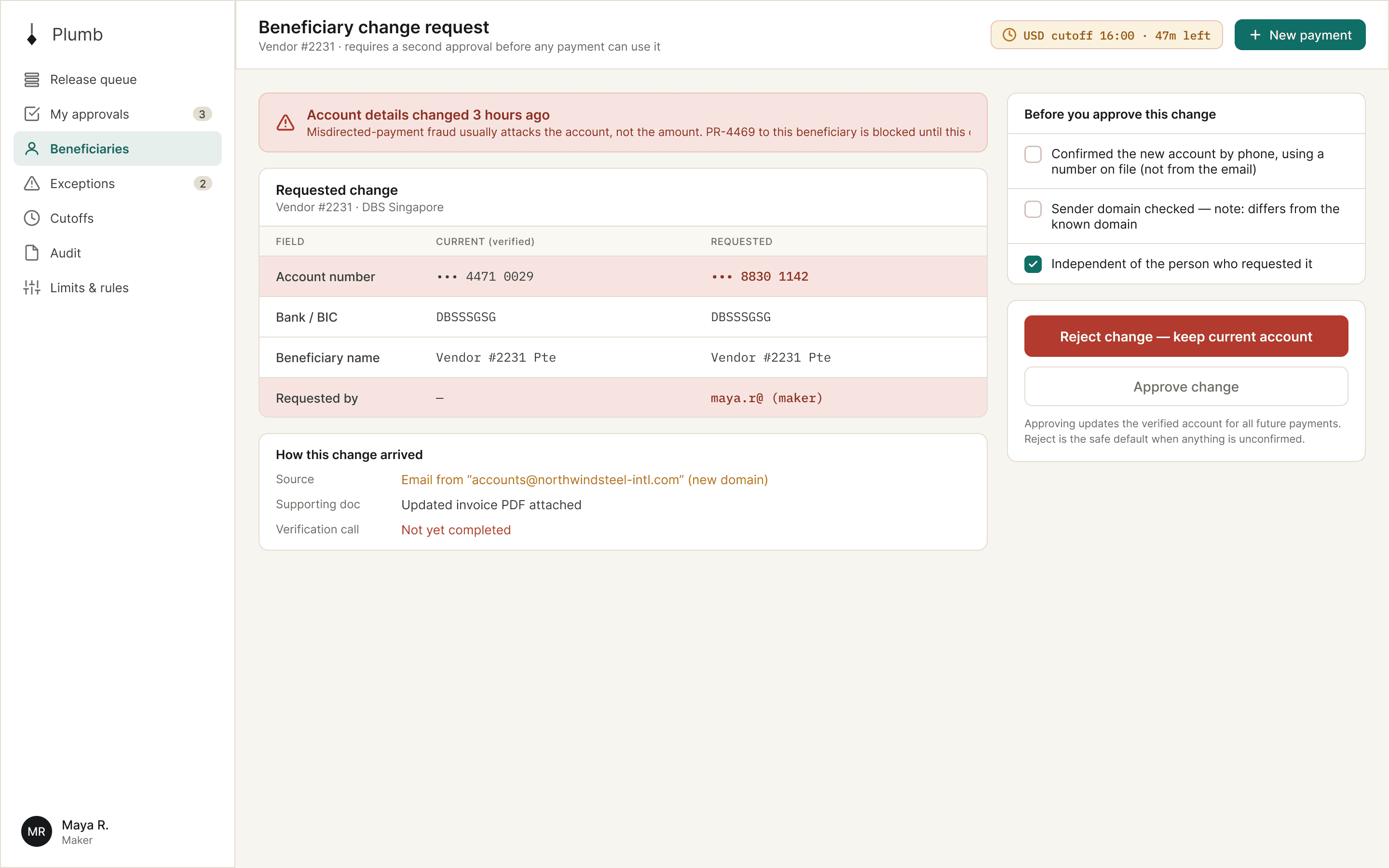
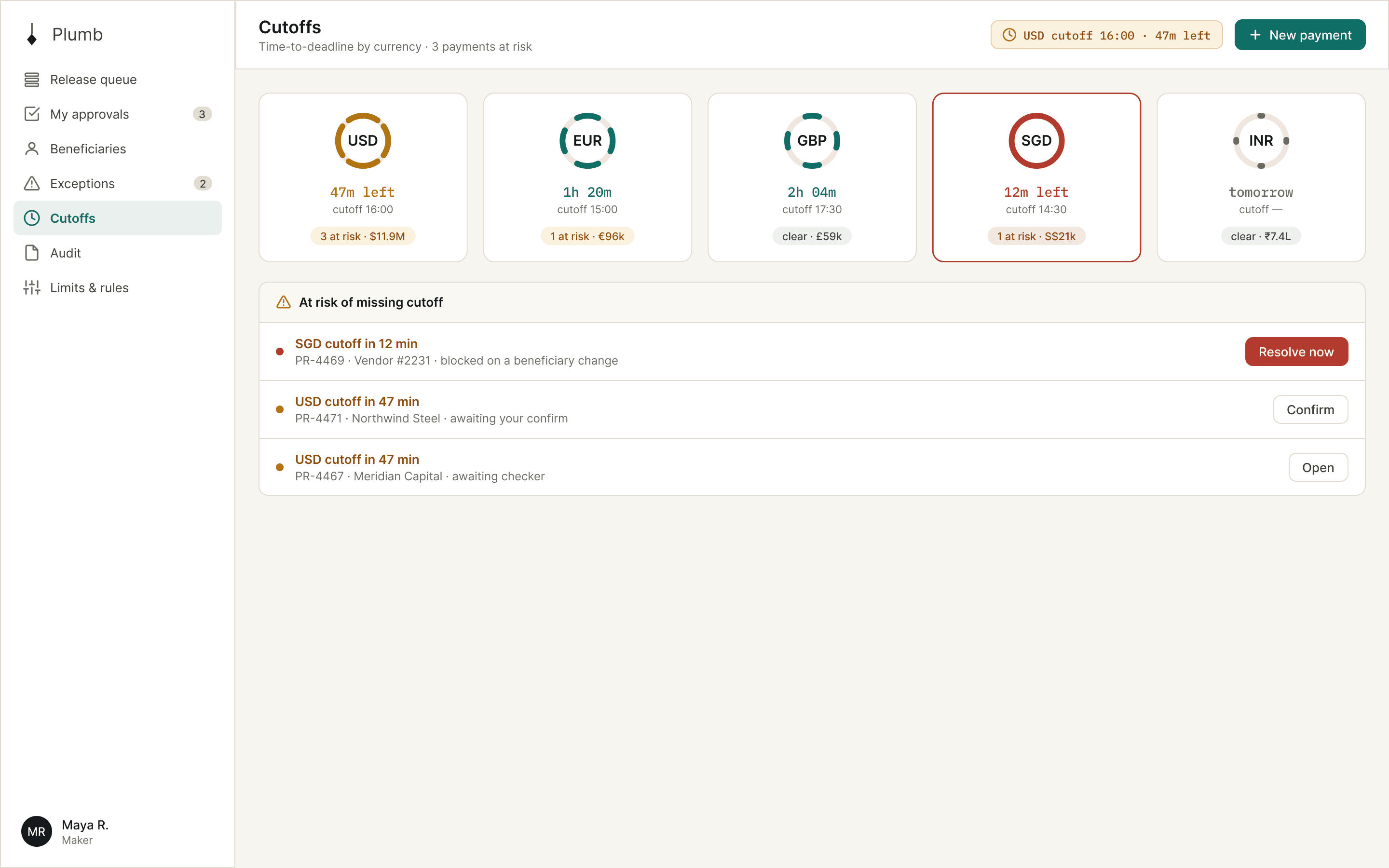
Plumb is a concept, framed honestly — no real users, clients, or production metrics, and every cited figure is flagged as researched press, not a measured result. The deliverable is a focused desktop terminal designed around the release moment: the release queue with a value-at-risk and cutoff view, the Confirm-the-Amount ritual, diff-led four-eyes approval, dual-controlled beneficiary changes, and a per-currency cutoff dashboard — on a small ‘ink-on-paper’ design system where color only ever signals. Success is defined as testable hypotheses for the next step — fewer misread amounts and IBANs, injected magnitude errors caught by the ritual, and checkers rejecting planted bad-beneficiary changes more often than with a flat field list — to be validated in moderated usability tests with operations professionals.
- Designing for an irreversible action flips the usual goal: the win is sometimes adding friction — precisely, at the one step where speed is dangerous — not removing it.
- Legibility is a safety feature. Tabular monospace amounts, amount-in-words, and a diff aren’t decoration; they’re how a human catches the error a form lets slide.
- Control theatre is worse than no control. A four-eyes step that shows the checker 40 identical fields teaches them to rubber-stamp — leading with the diff is what makes the second pair of eyes real.
- It made the contrast with my agent-oversight project sharp: same rigour, opposite ends — one supervises autonomous agents, the other is an instrument for a human doing the work by hand.