Crease
Find your crease.
Find your crease.
- 01One Cue, not a metrics dashboard
- 02Surface the AI’s uncertainty instead of hiding it
- 03Sensorless and phone-only — reach over precision
A sensorless AI batting coach · one trustworthy cue per shot, built for the un-coached
India has ~3 million registered cricketers and tens of millions of casual ones — almost all of them un-coached. They practice in the nets with a phone but no one tells them why a shot felt wrong or what to fix next. Sensors like StanceBeam and academy coaches are out of reach; the sensorless apps that exist dump metrics. Crease is a sensorless, phone-camera AI batting coach: point a phone at the nets, play your shots, and get one glanceable, trustworthy fix at a time — wrapped in a habit loop built for the week-3 cliff.
Amateur cricketers practice without feedback and quit before progress shows. India has roughly 3 million registered cricketers and only ~1,030 male professionals — so the amateur base is essentially un-coached. Elite tools don’t reach them: StanceBeam needs a ₹-heavy smart bat; academies are expensive and far. Sensorless AI apps exist but skew toward bowler metric-dumps — pitch maps and ball speed — not glanceable batting-technique correction a beginner can act on. The amateur’s frustration is feedback that’s either absent (no coach) or overwhelming (a wall of numbers). Layered on top is a retention problem: about 1 in 3 gym members quit each year and a two-week inactivity gap spikes churn — solo practice falls off at the same week-3 cliff. (Figures are researched and flagged; the gym numbers are used as a behavioural proxy, not cricket-specific data.)
The feedback gap, not the data gap
The un-coached batter already has a phone and practice — what’s missing is someone to say why the shot was wrong and what to fix. That’s a design problem, not a sensor problem.
~85% accuracy is a design brief
Phone pose-estimation isn’t perfect, so honest confidence states aren’t an afterthought — they’re the thing that makes a noisy CV product trustworthy enough to use.
Most quit at week three
Solo practice drops off at the same cliff gym memberships do. A streak that forgives a rest day and a nudge timed to that moment beats raw gamification.
A coach’s eye in your pocket — one fix at a time.
One Cue, not a metrics dashboard
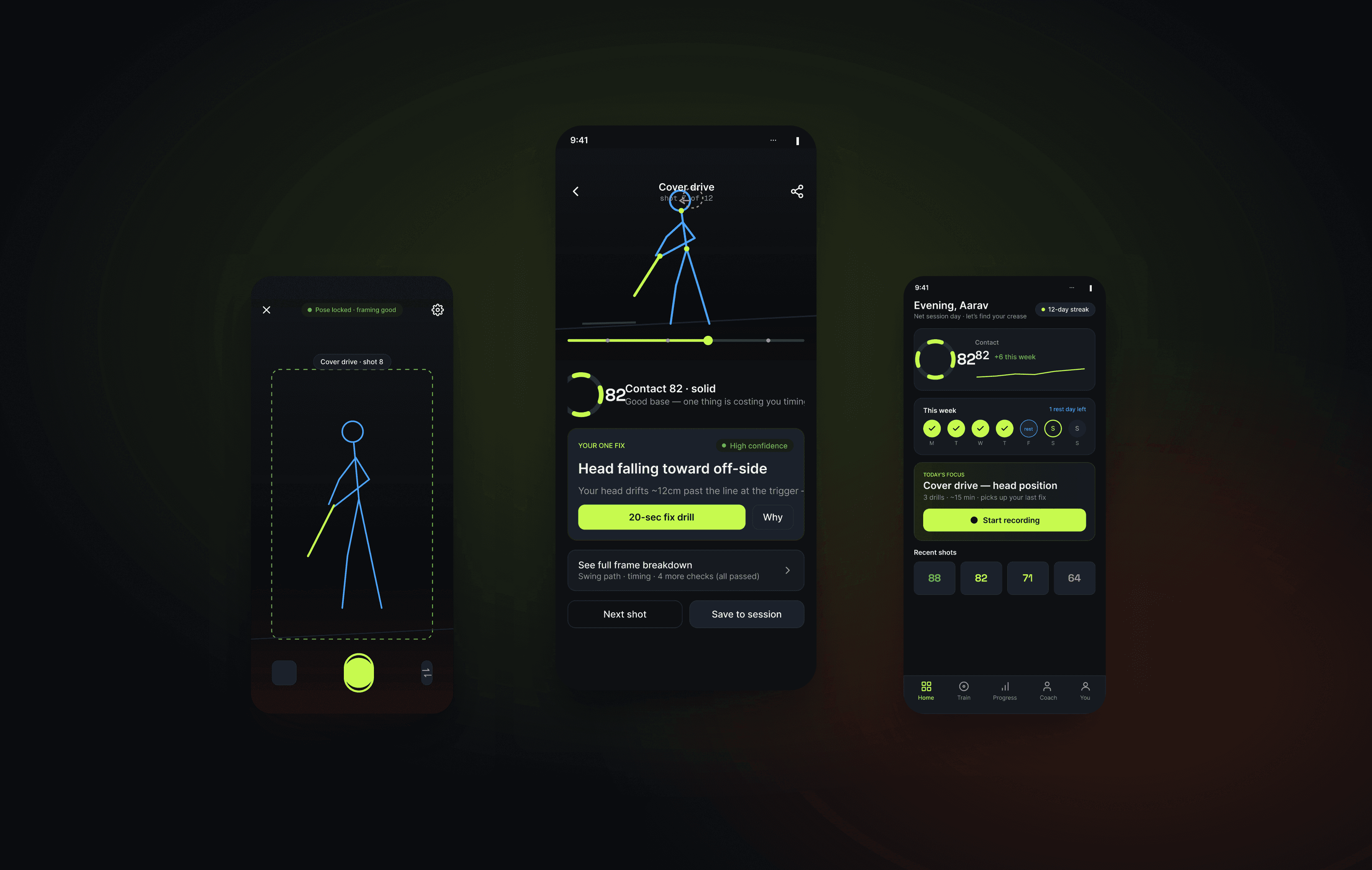
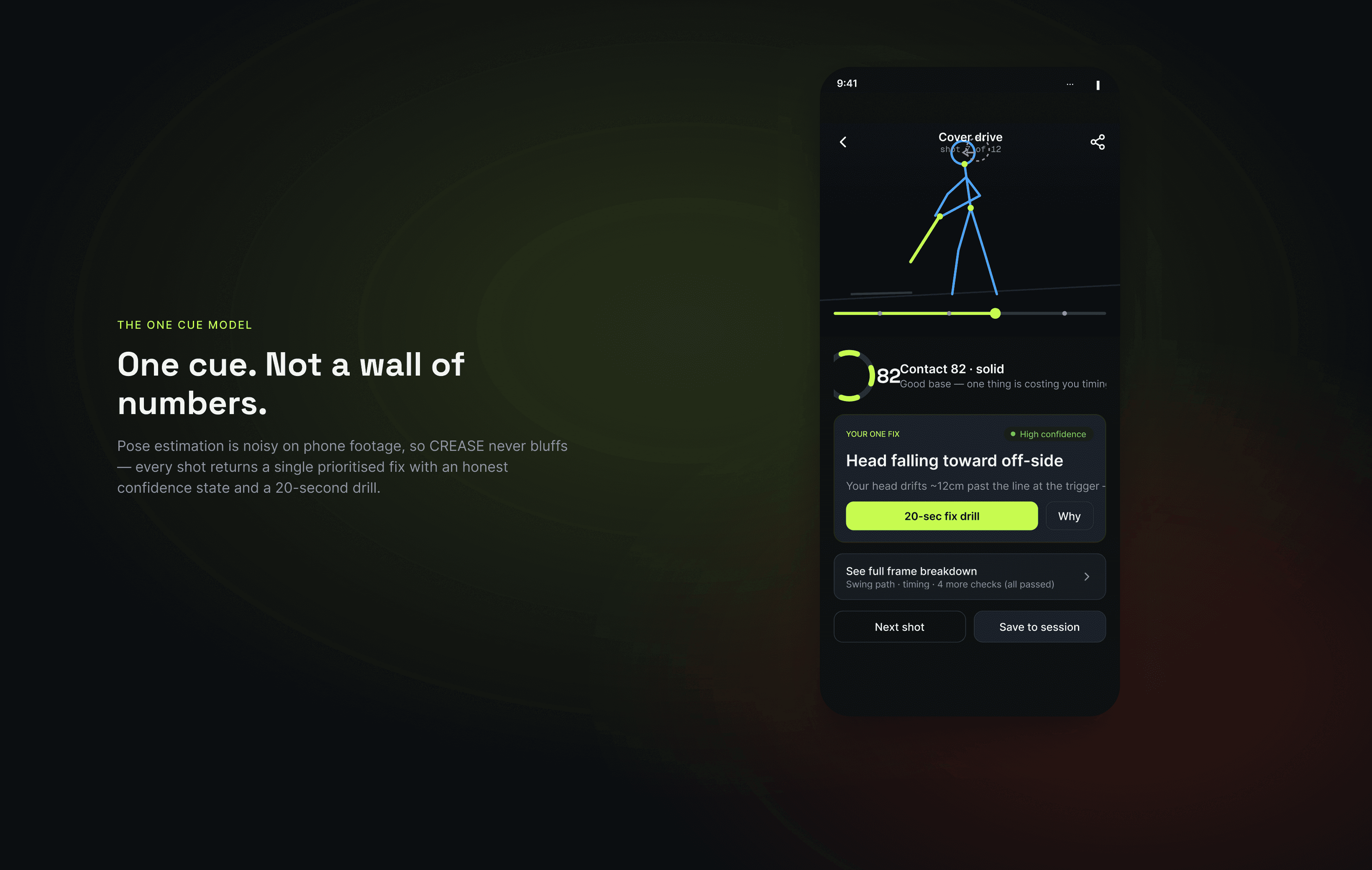
Each shot returns exactly one prioritised correction — “head falling toward off-side, keep it still over the ball” — with a confidence chip, a one-tap ‘why’, and a 20-second drill. Glanceable in under two seconds. Tradeoff: power users may want all the data, so the full breakdown is one tap behind the cue — but for the un-coached majority, focus beats completeness.
Surface the AI’s uncertainty instead of hiding it
Pose estimation on amateur phone footage is noisy (~83–87% stroke-classification accuracy in the research), so the UI never bluffs. Every cue carries an honest confidence state — High, Likely, or ‘Low light — can’t tell’ — with a reframe-the-camera nudge when detection is poor. Tradeoff: admitting uncertainty feels less magical, but honesty is the moat for a consumer CV product — a confident wrong cue destroys trust.
Sensorless and phone-only — reach over precision
No smart bat, no wearable: just a phone on a tripod or a stack of bricks. Tradeoff: lower precision than a sensor, accepted deliberately and managed with camera-setup guidance and the confidence states — because reach (every phone in India) beats precision (the few who buy hardware).
Engineer adherence for the week-3 cliff
A single signature metric (‘Contact’) replaces vanity numbers; the streak has a built-in rest-day freeze so a bad week doesn’t break it; and a re-engagement nudge is timed to the documented two-week churn point. Tradeoff: a freeze weakens raw streak pressure, but it prevents the burnout-quit — finishing beats flexing.
An async coach layer, not a marketplace
A coach can leave a 15-second voice or scribble note on any shot — bridging pure-AI and human coaching without building a whole marketplace. Tradeoff: less revenue and complexity than a coach platform; v1 stays focused on the solo loop, with the coach note as the bridge, not the business.
- ✕Smart-bat sensor (₹-heavy, elite)
- ✕A wall of numbers to decode
- ✕Confident even when the data’s noisy
- ✕Streaks that punish a missed day
- ✓Sensorless — any phone, any net
- ✓One glanceable cue per shot
- ✓Honest confidence: High / Likely / can’t-tell
- ✓A rest-day freeze tuned for week 3
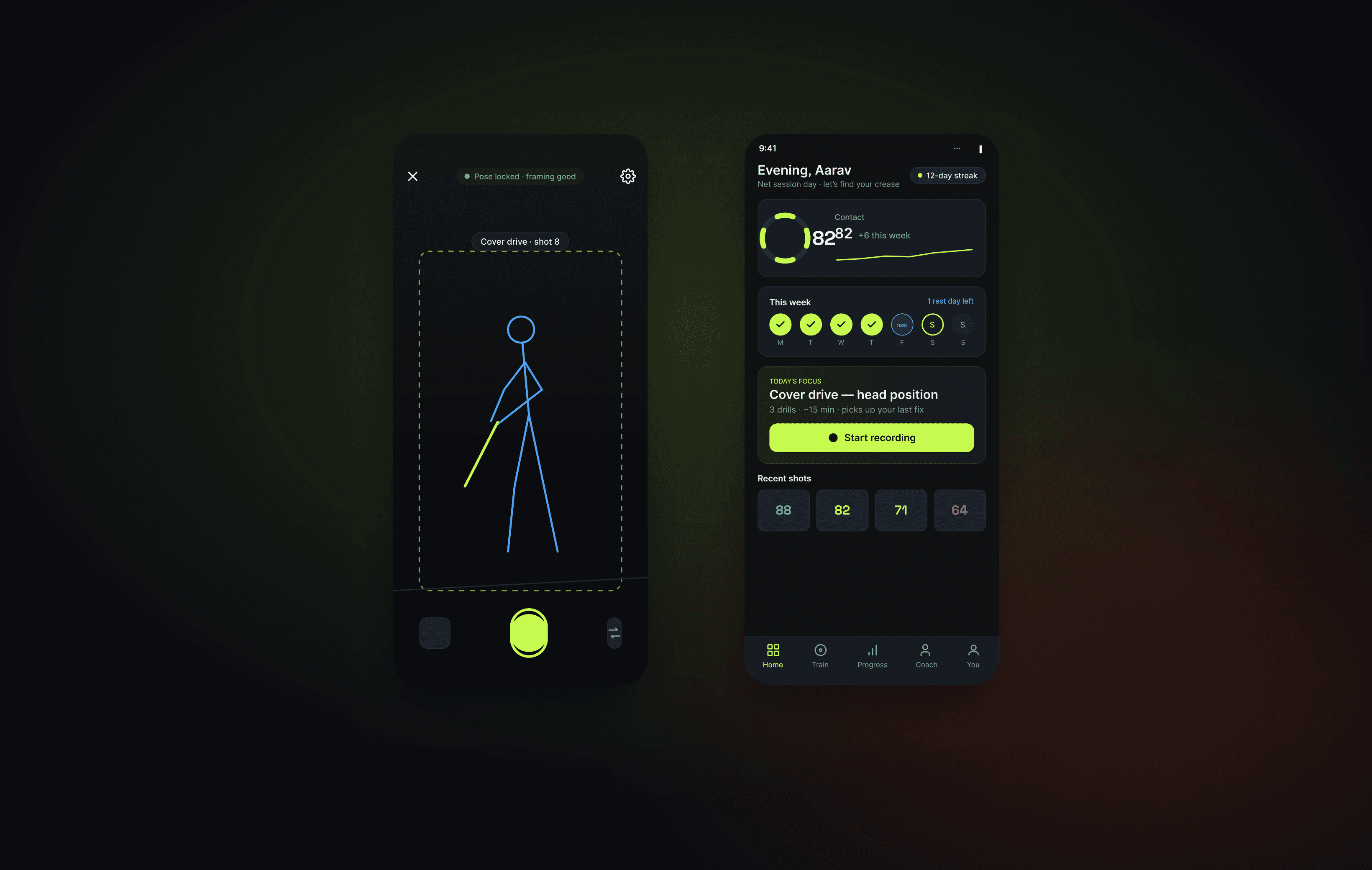
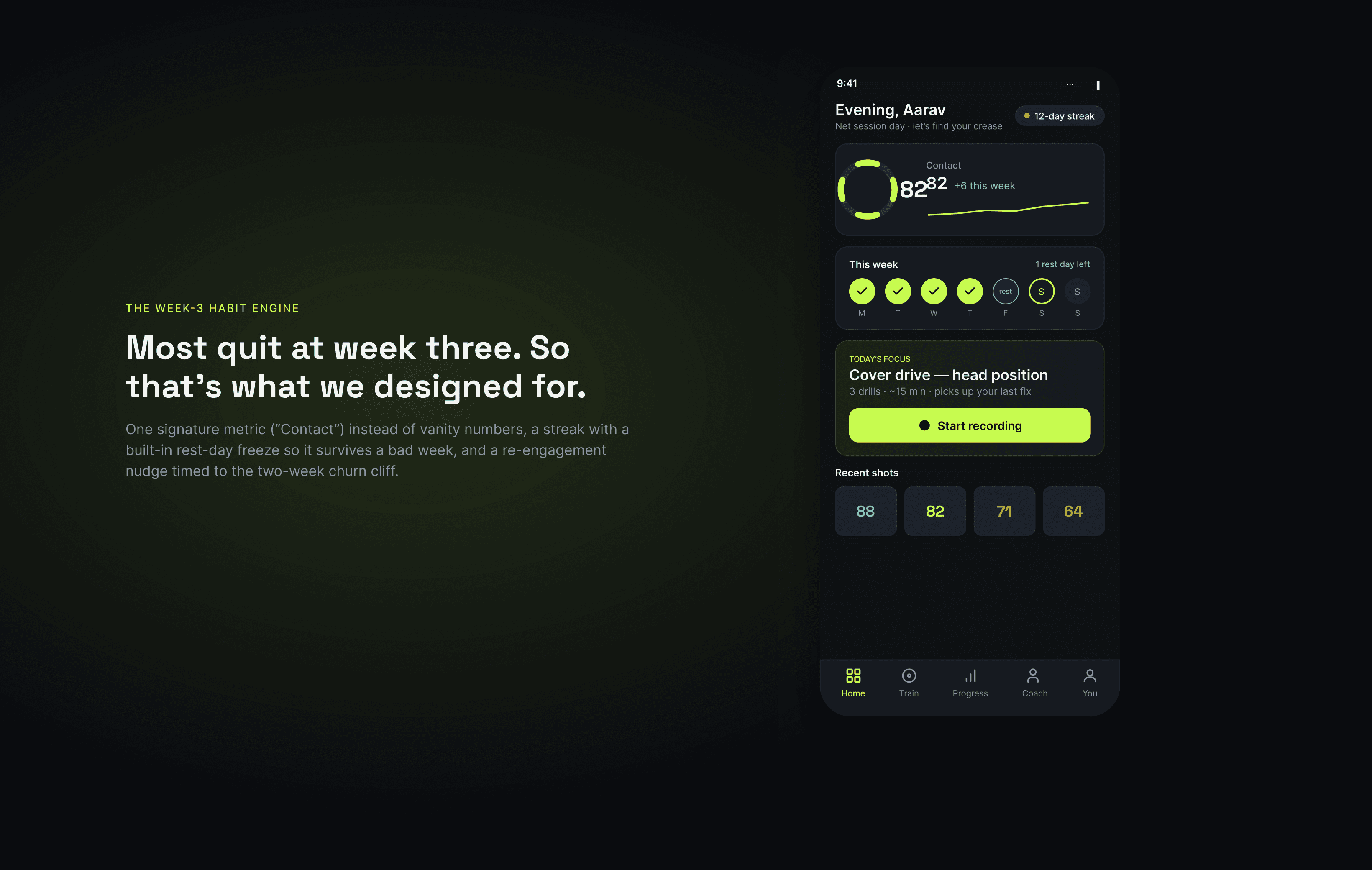
Crease is a concept, framed honestly — no real users or shipped metrics, and every figure is sourced and flagged (the soft ones, like casual-player counts and gym-retention-as-proxy, marked inline). The deliverable is a mobile system on one premium dark design system: onboarding and camera setup, the capture flow with a live pose skeleton and framing guidance, the Shot Report built around the One Cue model, the home/habit surface with the Contact meter and week-3 engine, and the trust-calibrated confidence states throughout. Success is defined as concept goals and test intentions — a first-timer getting one trustworthy, actionable cue within 60 seconds of their first recording; feedback glanceable in under two seconds; never a cue the AI isn’t confident about — to be validated with 5–8 amateur cricketers.
- For a consumer CV product, designing the AI’s honesty (its confidence and its ‘I can’t tell’) is more important than designing its confidence — a wrong cue shown boldly is worse than no cue.
- Constraint is the feature: returning one cue instead of twenty is harder to design and far more useful to a beginner than a complete metric dump.
- Retention is a design problem, not a notification problem — the rest-day freeze and a nudge timed to the real churn cliff do more than streak pressure.
- Knowing the domain matters: cricket-specific cues, the leather-red accent, and the crease-line motif make it feel made for the player, not a generic form-checker reskinned.