FIXIT.
Point your camera at something broken. Fixit tells you what is wrong, how sure it is, and how to fix it. When the job is dangerous, it stops and helps you find a professional.
View the walkthrough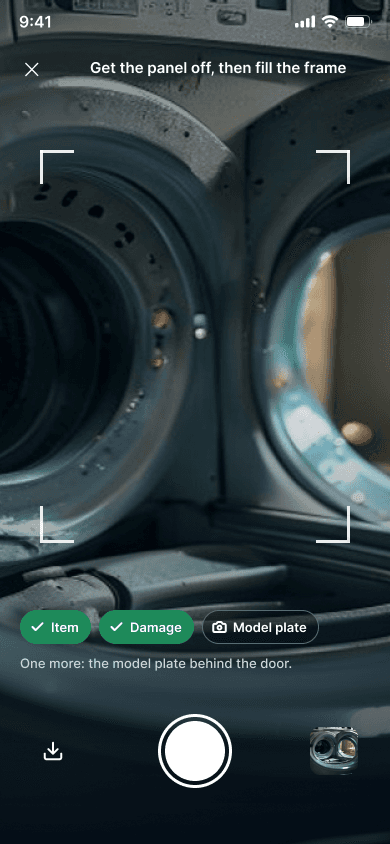
◇Overview
A calmer way to fix the things you already own.
People replace things that still work because fixing them is hard to start. In the interviews, the same three problems came up: people did not know what was wrong, did not know what the part was called, and were afraid of making it worse or getting hurt.
Fixit is built around those three problems. You photograph the broken item instead of naming it. The app tells you what is likely wrong and how sure it is, walks you through the repair one step at a time, and stops and helps you find a professional when a repair is unsafe.
- 62M tonnes
- of e-waste in 2022; only 22.3% formally collected (ITU, 2024)
- 82M tonnes
- of e-waste forecast by 2030
- 6 interviews
- plus 34 survey responses, 5 testers per round
- Whirlpool WTW5000
- the worked example throughout, a drain-pump fault
- $18.40 vs $400
- the part from PartSelect against a shop's replace quote
- 41% → 92%
- the low-confidence loop, once a better photo is taken
- 4 fixed, 1 gave up
- one user's first month, $312 saved after $96 of parts
- One design system
- every screen built from the same tokens
01The problem
People give up on things they could fix, because starting feels risky.
A repairable item usually needs one part and one hour. But before any of that, a person has to figure out what is wrong, what it is called, and whether they will hurt themselves or make it worse. Most people never get past that first wall, so the item goes in a closet, then in the trash.
They can't name the fault.
Without the word, they can't even search for help.
They're afraid.
Of breaking it more, voiding the warranty, or getting a shock.
They can't trust what they find.
A chatbot sounds sure, but offers no way to check.
02Research
Find out how people fix things now, and where they stall.
- —Learn how people find and attempt repairs today
- —Find the exact moments where they give up
- —Test whether a camera-first approach removes the first barrier
- User interviews
- Short survey
- Competitive analysis
- 6 interviews, 34 surveyed
- Ages 27 to 58
- Renters and homeowners
- In person and video call
- Each had a recent, real repair
- Varying DIY confidence
Fixing it felt like a gamble I’d probably lose, so I bought a new one.
I don’t even know what the part is called, so I don’t know what to search for.
Trying to fix something should feel doable. Instead it feels like a gamble people expect to lose, so they stop before they start.
The tools that already exist all start after the hardest step — working out what is wrong.
| TOOL | GOOD AT | FALLS SHORT |
|---|---|---|
| YouTube | +Huge free library | –You must know the exact term to find the right video –No safety checks, nothing specific to your unit |
| iFixit | +Excellent guides and community | –Guide-first, not diagnosis-first; you still identify the fault yourself –Skews to electronics |
| General AI chat | +Fast and conversational | –Can't see your item, and is confidently wrong –No safety limits, no sense of how sure it is |
| Maker support | +Accurate for your exact model | –Buried and slow –Pushes you toward paid service |
03Define
Turn the interviews into people and priorities.
Grouping the notes by theme, the barrier was rarely skill. It was uncertainty and safety — not knowing what was wrong, and not trusting the answers people found.
Three people carried the needs the research surfaced. Each one maps to a decision the app had to make.
“I want to know it's safe to try before I take anything apart.”
- Age
- 29
- Occupation
- Marketing coordinator
- Status
- Renting, lives alone
- Location
- Austin, TX
Priya rents a one-bedroom flat and is careful with money and with her deposit. Her dishwasher stopped draining a month ago. She watched one video, didn't recognize a single part, and worried that opening it up would flood the kitchen or breach her lease. So it sits there while she debates calling a plumber she can't really afford. She'd happily fix small things herself if something told her, plainly, whether it was safe and where to start.
- Fix small household problems without calling a pro every time
- Avoid anything that risks her deposit or her safety
- Doesn't know the name of the part, so she can't search for help
- Afraid of making it worse or flooding the kitchen
- Generic AI answers sound confident but she can't trust them
- To be told plainly what's wrong and whether it's safe to touch
- Step-by-step guidance she can follow with no experience
- A reactive repair companion. Something breaks, you scan it, you get a fix.
- Honest about how sure it is, including when it is not sure.
- Willing to step back on dangerous work.
- A maintenance-reminder app. It does not nudge you or invent chores.
- A marketplace. It hands parts to a real supplier; it does not sell them.
- A replacement for a professional on unsafe jobs.
04Ideation
Shape the features around the three barriers.
How might we help someone fix something when they don’t know what’s wrong, and can’t tell if it’s safe?
Capture
Photograph the broken thing. No need to name it. This removes the step everyone got stuck on.
Confidence-ranked diagnosis
Likely faults, each with a plain-language certainty, based on what the photo shows. Not a generic answer.
Guided repair
One step at a time, with the specific part and tool named.
Safety stop
For unsafe jobs the app stops and helps you find a professional, and passes on your photo and findings so you do not pay to diagnose twice.
Honest outcomes
Every repair ends as one of three states — fixed, waiting on a part, or gave up — and the app records all three.
It took three versions to settle where a repair lives while it is still going.
Everything on Home. It broke as soon as a user had more than one repair going.
Added a Library, but finished and unfinished repairs were mixed together.
Split by state. This is where the three outcome labels came from.
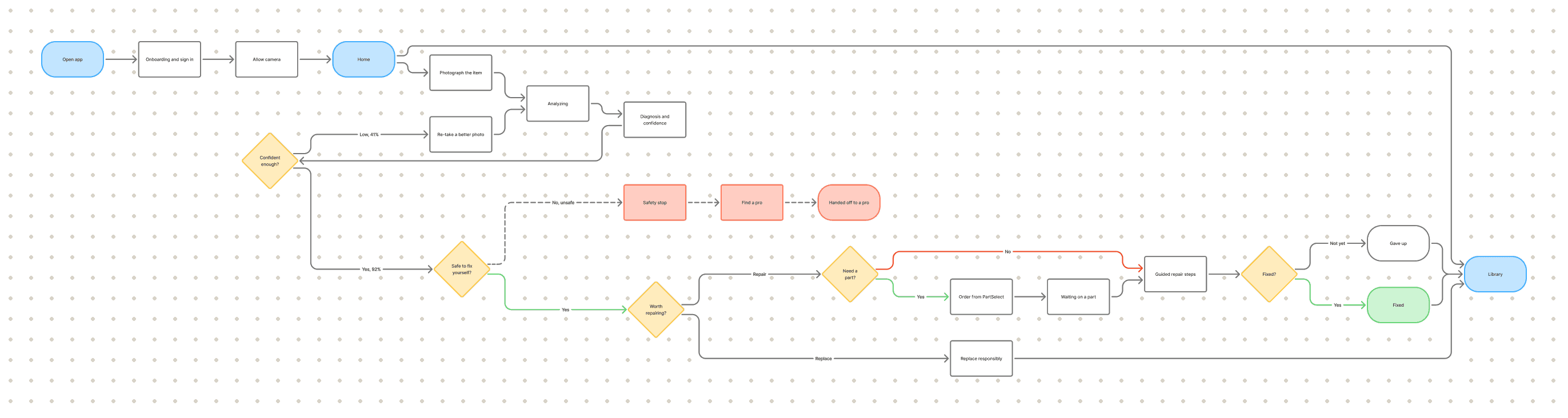
The core loop, including the point where the app refuses and hands you off to a professional. Drawn in FigJam.
Instead of wireframes, the first version of the screens was generated with AI and put in front of testers as it was. It looked clean, but it sounded more confident than it was, and people did not trust it. The redesign that follows came out of that testing.

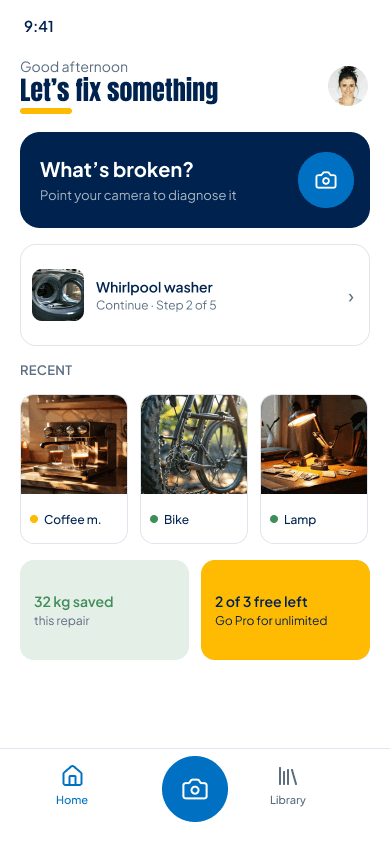
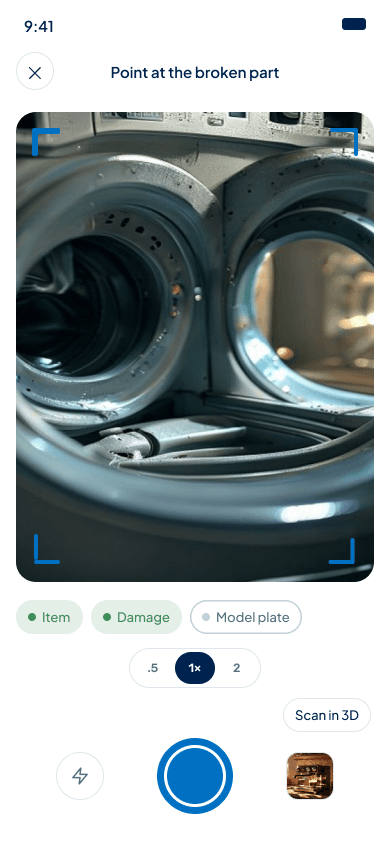
Each of the three main flows answers a problem the research surfaced.
People can't name what's wrong, so they don't even know what to search for. The item just sits in a closet.
- ·Photograph the item, no need to name the part
- ·The likely fault, ranked, with how sure the app is
- ·A re-shot when confidence is low, 41% to 92%
People are afraid of getting hurt, and generic tools push them on with no safety check.
- ·On unsafe jobs the app stops instead of guessing
- ·Hands your photo and findings to a nearby pro, so you don't pay to diagnose twice
People can't tell if a repair is worth it, or where to get the right part.
- ·An honest ledger: $18.40 to fix vs $400 to replace
- ·Order the exact part from PartSelect
- ·Log the outcome: fixed, waiting, or gave up
05Iterate + validate
Test the base flow before building further.
Before building the full app, I put the core flow in front of five people — scan a broken item, read the diagnosis, decide whether to keep going — to check it was clear, trusted, and safe.
- 5 testers
- Ages 27 to 52
- Different DIY habits
- Scan a broken item
- Read the diagnosis
- Decide whether to continue
- Is the flow clear?
- Do they trust the result?
- Do they know when it's unsafe?
Users did not want a confident answer. They wanted to see why, and how sure.
I was against showing low confidence. I thought a number like 41% would scare people off. I was wrong. When the app admitted it was unsure and asked for a better photo, people trusted it more, not less.
5 of 5 wanted to see what the diagnosis was based on. A bare answer felt like a gamble.
Shown a made-up 98% confidence with no reason, people trusted it less, not more.
Everyone asked some version of “what if it's wrong?”
06Branding
An honest mechanic, not a hype app.
The name says exactly what the app does. The look backs that up. One calm navy, plenty of white, and a single blue that only ever means “this is the action.” No gradients, no celebration screens, no badges or streaks. The only bright colours are the three outcome states, because those carry real meaning.
Colour palette
Typeface
07Design + prototype
From a confident answer to an honest one.
The high-fidelity screens are where the honesty had to become real interface. Most of the changes came straight from testing. Here is what moved, and why.
- ·Grounded every diagnosis in the photo the user took.
- ·Added the waiting on a part and gave up states.
On the fix-or-replace screen I first labelled the odds “if the fix works, 92%.” But 92% was the app’s confidence that the drain pump is the fault, not the odds the repair succeeds. A correct diagnosis can still fail if you strip a screw.
I relabelled it “if we’re right about the pump, 92%, if we’re wrong, 8%,” and separated our diagnosis from your choice. Getting a number wrong in a way that still reads fine is the exact trap this app is meant to help people avoid.
Admitting uncertainty and refusing dangerous jobs made people trust the app more, not less.
- ·Clearer wording on the safety stop
- ·A way to save a repair for later
- ·Show the part price sooner
- ·Live part pricing from a supplier
- ·Offline mode for basements
- ·Describe a fault out loud
- ·Honest confidence, high and low
- ·The safety stop
- ·The “gave up” state
08Final design
Every screen on one system.
The finished flow, screen by screen. The handoff covers the full set, not just the happy path: the low-confidence loop, the safety stop, edge cases, and the error and empty states.
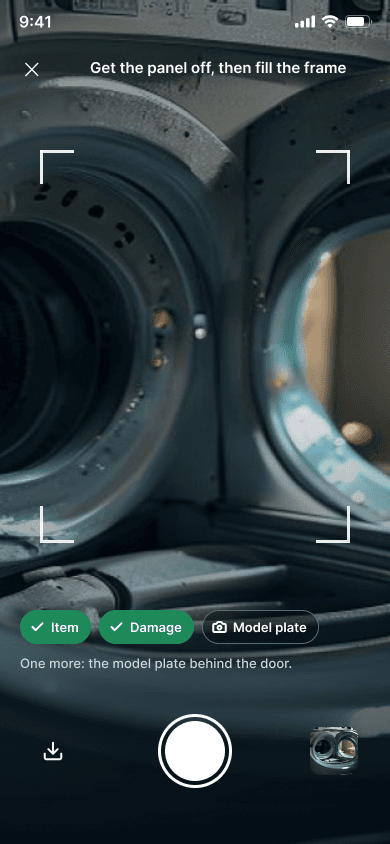
Capture
You start by pointing the camera at the broken part. There is no search box and nothing to name, because “I don't know what it's called” was the first place people got stuck. A live checklist shows what the app still needs — the item, the damage, the model plate — so you end up with one good set of photos instead of a vague guess.
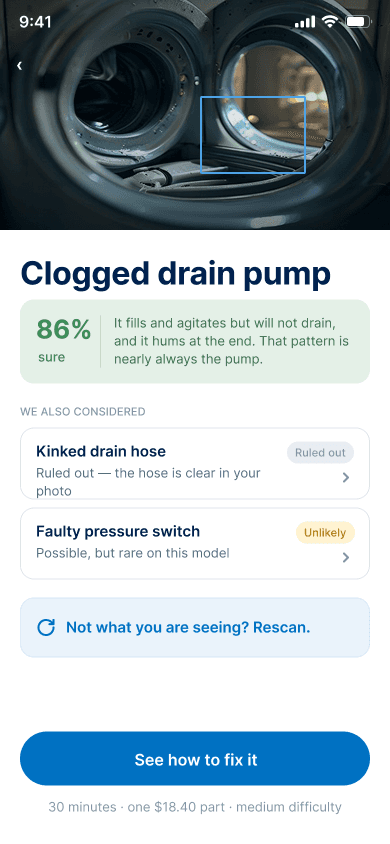
Diagnosis and confidence
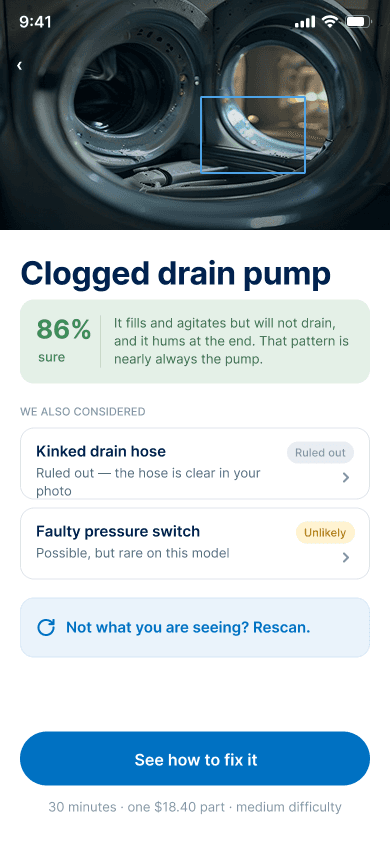
The result leads with the most likely fault and a plain-language certainty, not a single confident verdict. Below it, the app shows what else it considered and why it ruled those out, so the answer can be checked rather than taken on faith. In testing this beat a bare 98 percent.
When it isn't sure
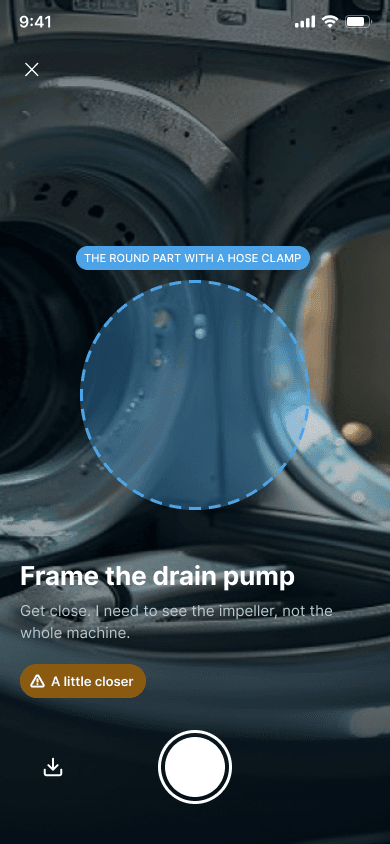
When the photo is not clear enough, the app does not fake certainty. It says exactly what it needs — “get close, I need to see the impeller” — and asks for a better shot before it commits. Once you re-frame, its confidence climbs and it tells you why it changed. This was the single most trusted moment in testing.
Guided repair
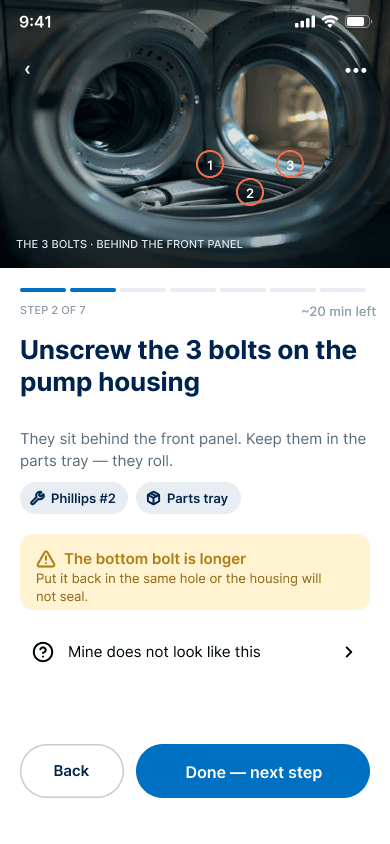
Repairs run one step at a time, never a wall of instructions. Each step names the exact tool, tells you where the parts go, and flags the small traps that ruin a job, like a longer bottom bolt that has to go back in the same hole. A progress bar keeps it honest about how much is left.
Safety stop
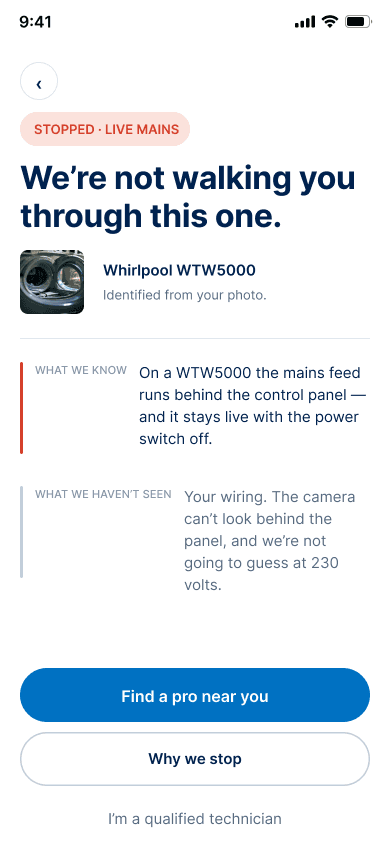
When a job crosses into danger — live mains, gas — the app stops instead of walking you through it. It is specific about why, and honest about its own blind spots under “what we haven't seen.” Then it turns the no into a handover: it finds a pro nearby and carries your photo and findings across.
Honest outcomes
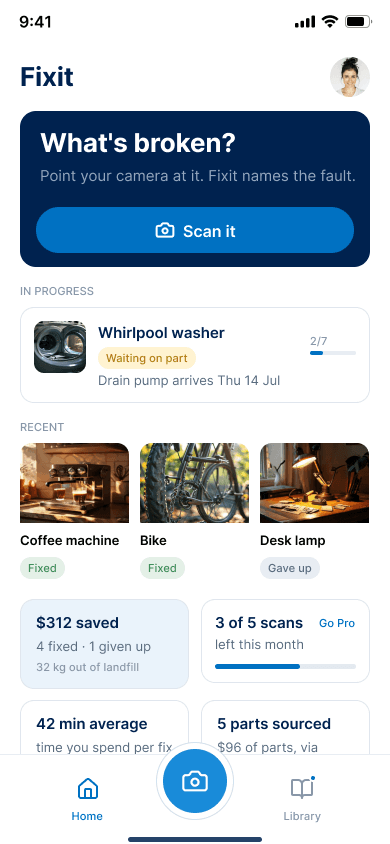
Home keeps every repair, and every outcome, including the ones apps usually hide. The desk lamp reads “gave up” right next to the wins, and a repair waiting on a part shows exactly what it is waiting for. The impact is grounded, not vanity: dollars saved after the cost of parts, with no invented carbon number.
09Conclusion
Reflection & learnings
The honest version — the one that admits when it’s unsure and refuses dangerous work — tested better than the confident version every time.
Early on I designed to make the screens look polished, and I kept filling empty space with features nobody asked for. Testing pushed me the other way. The hardest lesson was checking my own numbers: I shipped a screen that confused diagnosis confidence with repair odds, and it read fine until I looked twice. It is the exact mistake this app is built to catch, and I nearly shipped it anyway.
There is plenty left to prove. The most important next step is testing with real broken items in bad lighting, not clean stock photos, and checking the safety rules with a real appliance repair professional before any of this gets built. After that, the roadmap is live part pricing through a supplier, an offline mode for basements with no signal, and a way to describe a fault out loud when a photo is not enough.